 Français (France)
  Finnish (FI)
  English (United Kingdom)




Let's combine together the earlier post 'Why do project trainings rarely produce results?' and concept of project success vector as described in the LinkedIn newsletter.
Clearly when aiming to results through project trainings there are factors related to the training itself, to the trainee and to the organisation (figure 1).
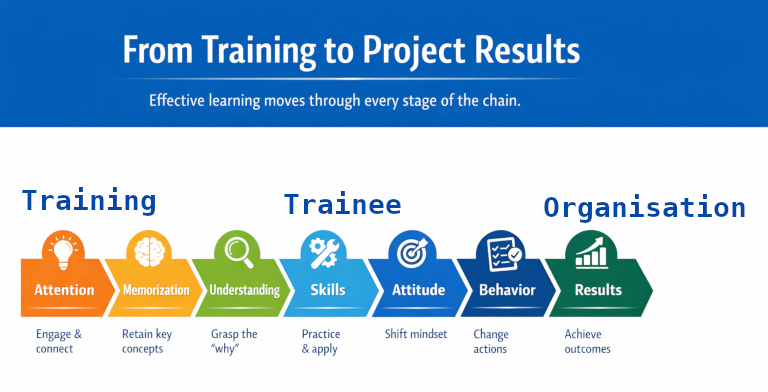
Figure 1. From training to results.
Project success vector was divided into 3 components: stakeholder satisfaction, achievement of benefits and planning accuracy (figure 2).
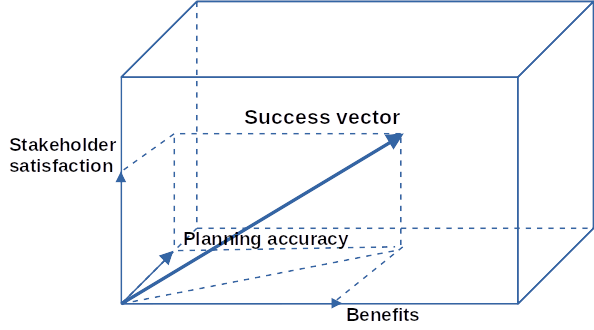
Figure 2. Project success vector.
Starting point
The longer the components are, the longer the resultant vector. Factors related to the training contribute most closely to the planning accuracy, somewhat to stakeholder satisfaction as well. It, however, requires that the students (trainees) grasp and understand the concepts, and more specifically can apply them to their business or projects. Do not just send employees to trainings. Instead ask the training provider:
- Does the provider have a lesson plan and a learning diary, or similar documents, supporting the understanding and acquisition of new skills, and are they also used after the training?
- Can the training be adapted to your reality and support the application of learnings in your own projects?
Moving further
Your real work as a trainee starts after the training. Successful project execution often requires a change in mindset: moving from realism to optimism, from anticipation to reactivity, and from hiding behind roles to taking responsibility. Attitude changes gradually when you acquire new skills and see the benefits of effective professional project management in your everyday work.
Through practice you are further growing the components of planning accuracy and stakeholder satisfaction, somewhat also the one related to achievement of benefits, although the last one requires also proper organisational practices and environment.
Before attending training, ask yourself:
- Can I apply the learnings to my own projects and gradually acquire new skills during the training and after it?
- Do I have time to revisit what I learned in order to further support the acquisition of new skills?
- Do I have the proper mindset to change behavior and instill habits through consistent long-term practice?
Final step
You need a supporting organisation to futher grow the components of planning accuracy and stakeholder satisfaction and ensure the achievement of benefits. Project owners may not understand project management concepts, current processes or mindsets do not allow for adequate management of projects, the project manager’s authority is unclear, or problems may be hidden.
Before training, check from your own organization:
- Does the organisation have a proper project culture supporting their execution?
- Do current processes and mindsets contribute to the implementation of learnings?
- Do project managers have sufficient authority to successfully lead projects?
Through concept of success vector you can start the necessary, sometimes painful, practice and conversation related to above mentioned topics.