 Français (France)
  Finnish (FI)
  English (United Kingdom)



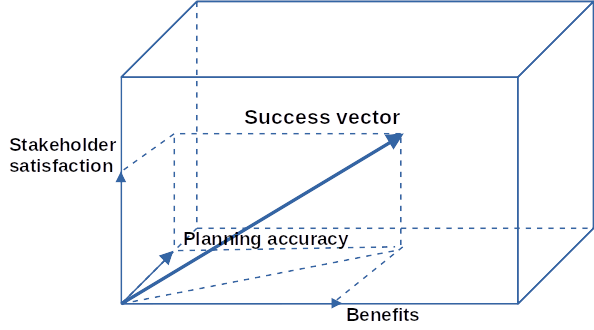
Our site hosts two content tracks that live side by side: the project success vector, which describes what success means, and the PM² methodology, which describes how to succeed. This article connects the two — with a particular focus on EU-funded projects.
How are these things connected?
The success vector answers whether the project succeeded by looking at three different dimensions. However, it is a metric, and doesn't tell what to do. PM², on the other hand, is an operating model consisting of the governance model, lifecycle, processes, and artefacts through which the project is guided towards its objectives. Together they form an efficient toolbox for successful project execution.
Stakeholder satisfaction and the PM² governance model
Stakeholder satisfaction — or legitimacy — doesn't happen by accident. It flows directly from PM²'s governance model (Pillar 1): clearly defined roles (Project Owner, Project Manager, Business Manager, Project Steering Committee) and the decision responsibilities ensure stakeholders always know where the project is heading and who is accountable for what. In an EU-funded project, this means the funder, the steering committee, and the implementing organisation share the same picture, thereby strengthening confidence in the planned execution of the project.
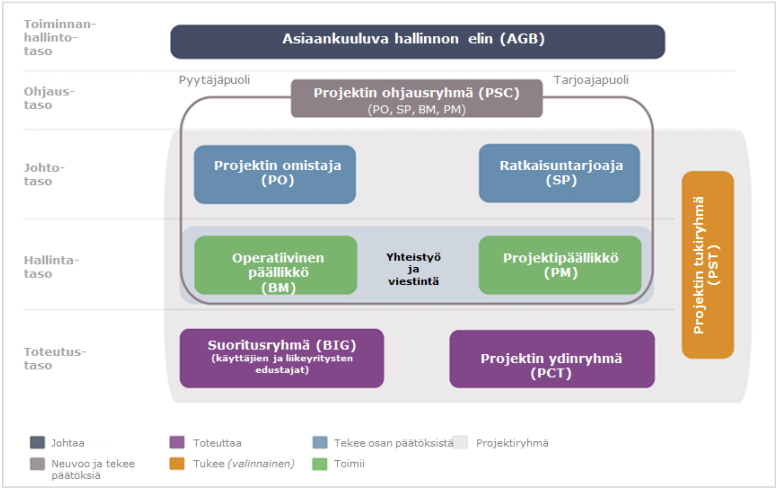
Governance isn't bureaucracy, but the structure promoting mutual trust and stakeholder satisfaction.
Benefits realisation and PM²'s artefacts
The success vector's second dimension, benefits realisation, is often left at chance, unless it has been taken care of from the beginning of the project. This is where PM² offers a concrete toolkit:
| PM² document | Role in benefits realisation |
|---|---|
| Business Case | Defines the targeted benefits at the initiation phase, and justifies the investment. |
| Business Implementation Plan | Describes how — and by whom — the benefits will be realised once the project's outputs have been delivered. |
| Transition Plan | Ensures the project's outputs move into operational use in a controlled way — without it, benefits often fail to materialise after the project closes. |
Without these documents, a benefit is just a claim.
Planning accuracy, lifecycle, and processes
The third dimension, planning accuracy, describes how well the execution corresponds to the plan — regarding resources, schedule, cost, and scope. This connects directly to PM²'s lifecycle (Pillar 2) and processes (Pillar 3). Phases (Initiating, Planning, Executing, Closing) with defined control gates prevent deviations from growing out of control before they are addressed.
This is also where Monte Carlo simulation enters the picture: Simulation gives us the forecasted probability distribution of project's duration and total cost — particularly relevant in EU projects, where schedule and cost pressure tend to be significant.
Wrapping up
| Success vector dimension | PM² element |
|---|---|
| Stakeholder satisfaction | Governance model (Pillar 1) |
| Benefits realisation | Business Case, Business Implementation Plan, Transition Plan |
| Planning accuracy | Lifecycle and processes (Pillars 2–3) + Monte Carlo simulation |
The success vector and PM² are thus not separate tools — they're two sides of the same coin: one tells what to measure, the other how the desired result is achieved.